The Roots of Germany
When Noach (KJV: Noah) and his three sons departed the Ark after the Flood, Noach immediately made plans to repopulate the earth as Yahuah had commanded (Genesis 9:1, 7). The books of Jasher and Jubilees outlined what sons would obtain what lands. Shem, the oldest of Noach's sons was designated to receive the middle of the earth, while Cham would receive the lands to the south, most notable Africa. The third of Noach's sons Yapeth would receive the lands of the North. Part of that land grant would be Central Europe. However, its lush forests and fertile lands would become attractive to other tribes as well.
Sadly, much of ancient history of Central Europe was never written down. The early Germanic languages did not normally have a written component, and when they did, it was not consistent from tribe to tribe. This does not mean though that there were not attempts to discover these cultures. During the early years of National Socialist Germany from 1933-1940, Heinrich Himmler, the head of the SS set up an organization called the Ahnenerbe run by Wolfram Sievers which spent a lot of money trying to discover the early history of Germany. While they did a lot of work, much of it was lost after World War II.
The first real mention of the Germanic tribes was written Roman history when Caesar Augustus tried to invade Central Europe and failed, often misreably. One of their worst losses was the Battle of the Teutoburg Forest around A.D. 9. Led by a Germanic chieftain Arminiuis, the tribes routed three Roman legions, effectively ending Ceasar Augustus' campaign of conquest in Central Europe. The Romans would try several times afterward, almost always with the same result.
The wars between Rome and the Germanic tribes would last another 400 years until 409-410 when the Visigoths laid siege to Rome and finally sacked it. While the Roman armies would exist for another two hundred years, most of them went east and became part of the Byzantine (Eastern Roman) Empire, which would last until 1453 when the Ottoman Turks took the Byzantine captital: Constantinople and renamed it Istanbul.
When the Western Roman Empire effectively collapsed in the fifth century, the Frankish Merovingian Dynasty led by Childeric I ruled much of France and Germany for about two hundred years. Even President Trump claims to be in the lineage of the Merovingian dynasty. Some tales have them descending from a sea-beast called a Quinotaur, which allegedly sired Merovech, the first of the Merovingian kings. While the French take great pride in claiming the Merovingians as their own, many people in Western Germany also take claim to them.
By the middle of the seventh century, the Carolingian Dynasty has taken over when Pepin the Short assumed rule over the Frankish Kingdom. The most notable events in this dynasty was the Battle of Tours in 732 when Charles Martel defeated the Umayyad Caliphate. While the Caliphate would remain in Europe another 30 years, they eventually had to leave because of internal problems at home. The other main Carolingian Dynasty event of the time was the crowing of King Charlamange in A.D. 800 by Pope Leo III at the Old St. Peter's Basilica on December 25. His crowning was considered by many historians as the beginning of the Holy Roman Empire.
When Charlamagne I died in 814, the polical situation got rather complicated. His will was unclear in spots and his wishes for succession were not well-known. Finally, in 843, the Carolingian family negotiated The Treaty of Verdum outlining which family member got what lands. The most notable partition was Francia (now called France) whereas the center of the empire called the Kingdom of Italy controlled a stretch of land from the North Sea south to Rome. A third partition called East Francia covered the eastern part of the empire. This arrangement would end in 888 with the death of the final Carolingian king: Charles the Fat.
When the Carolingian Dynasty ended, Europe would descend into a continent of City-States, while the Kingdom of Germany king was effectively a figurehead kingdom. The Middle Ages would also see many tribes descend upon Germany thanks to the uprooting of many tribes from Central Asia. The Mongol invasions of the ninth through the twelfth centures drove a lot of tribes west. The Nordic tribes also found Germany a very nice location compared to the icy confines of Scandinavia. The Khazars from Central Asia found the land more peaceful than their former confines in Central Asia. They brought Judaism to Central Europe to counter the work of the Apostle Paul and others who brought Christianity. One of the more notable Christian moves was the Teutonic Knights who created the largest of the German states: Prussia.
The official German state did not begin until 1870 when Otto von Bismarck used some incredible diplomacy to unify 43 separate countries into the current state. Bismarck did get some "help" from the French, who resisted the idea of Prince Leopold of Hohenzollern going south to rule Spain. They did not like the idea of potentially fighting a two-front war against the Germanic states. When the French mobilized their troops in July of 1870, Bismark exploited the situation to get the German states to join him. The situation grew more heated when French troops occupied the German city of Saarbrücken. The Prussians reacted accordingly and the French commanders got "cold feet" and retreated across the Saar River back into France to establish defensive positions.
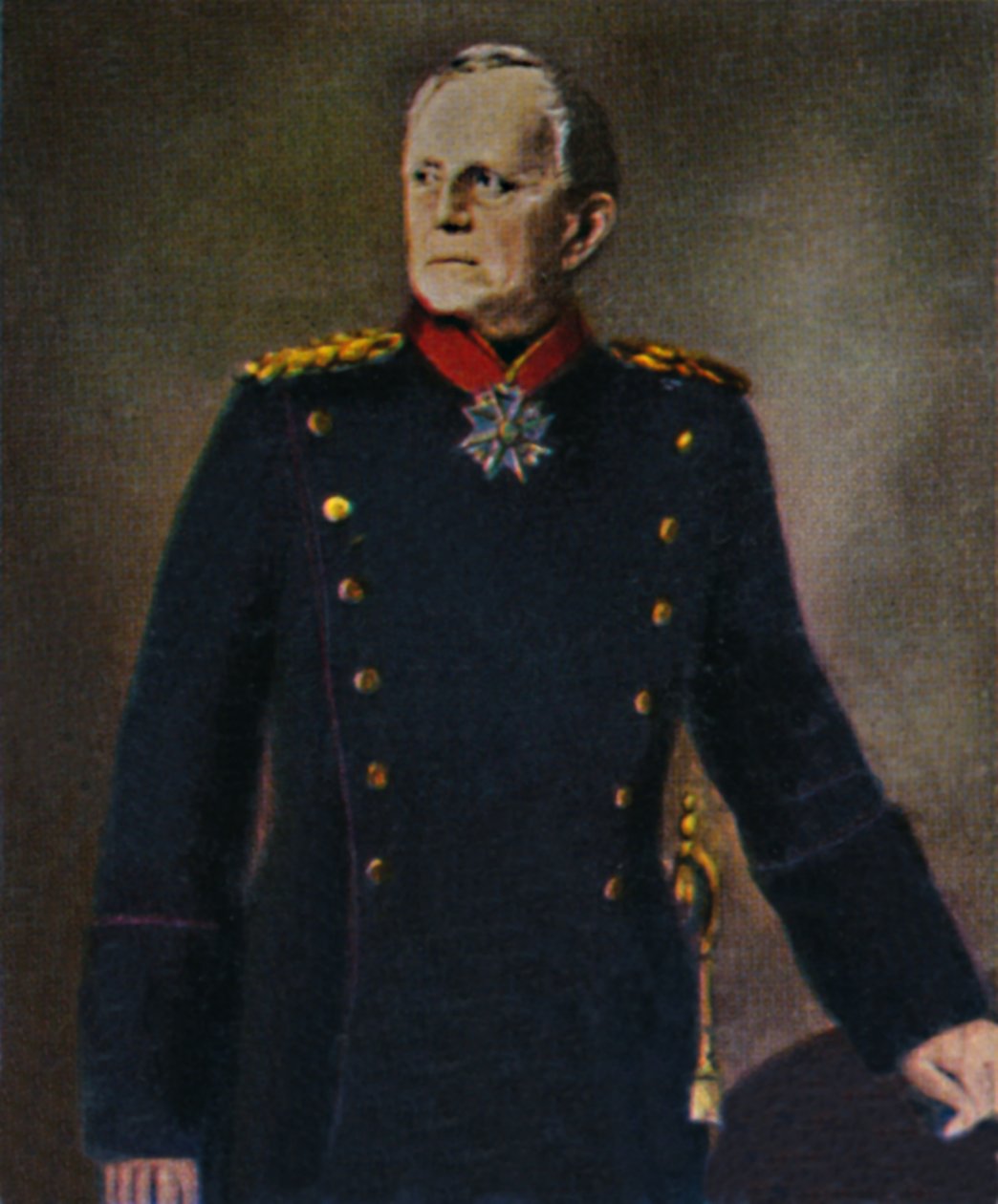 The French cold feet of Saarbrücken would prove to be a trend in the Franco-Prussian War. However, the Prussians biggest advantage was the management of their Army by Field Marshall Count Helmuth von Moltke the Elder (pictured to the right, the Elder to differentiate from a nephew with the same name). A student of the famous Prussian military theorist: Carl von Clausewitz, von Moltke developed a very fluid method of commanding troops and adjusting to changes in battle situations. Compared to the French theories of command, which was structurally more rigid, the Prussian Armies proved to be more effective. In the end, the Prussian Armies captured the French emperor: Louis Napoleon III at the Battle of Sedean. Then, they defeated the armies of the new French Republic, and ended up capturing the French capital: Paris. They negotiated a peace treaty, and much to von Moltke's credit, he and the Prussian Armies went home. He was content to let the French solve their own problems.
The Prussian influence over Germany remains a major factor in how they operate their military and in how they govern themselves. Religiously, they remained Lutheran unlike Bavaria, which continues to remain Roman Catholic. The unification of Germany in 1870 saw the effective merger of over 40 cultures, making for an insteresting Reichstag (the German Parliament). Even Otto von Bismarck would admit that unifying Germany was one thing, keeping them together was quite another. He did his best to avoid a lot of foreign entanglements, understanding that being the predominant nation in Europe brought with it a lot of responsibility. While he continued to maintain good relations with Kaiser Wilhelm I, when he died, his grandson: Kaiser Wilhelm II was not so agreeable. Bismarck was deposed and Germany began to assert their military and political autonomy in Europe and to a lesser extent, around the world.
Germany in the 20th century found itself in a hegemonic battle with the Austrian-Hungarian Empire, the French Republic, Great Britian, and Tsarist Russia. Entangeling alliance became a prominent for these countries to protect their interests. It started when Serbia, a small nation in the Balkan region made an alliance with fellow Orthodox nation Russia. Russia, concerned about the power and influence of Germany, chose to make an alliance with France. France, on the other hand, remembering the disaster of the Franco-Prussian War made an alliance with Great Britian. Germany, seeing a potential two-front war ahead of them, made alliances with the Austro-Hungarian Empire and the Ottoman Empire (now Turkeye). Couple that with rearmament programs prevalent in all these countries and a breeding ground for war is certain to follow.
When World War I erupted, the German Army attempted to employ the famous Aufmarsch I, the "Schlieffen Plan" to finish off France before dealing with Russia. Unfortunately, for Field Marshall Alfred von Schlieffen, he did not consider the fact that Great Britian and later, the United States would enter the War on the side of the Allies. The Great War would go on for four years before Germany would exhaust itself militarily and economically. When the Summer Offiensive of 1918 began to diminish, the Germans started to realize they would not be able to replentish their losees. After Kaiser Wilhelm II abdicated his throne and left for Belgium, the German government was forced to sign an "Armistace" that would bankrupt them for many years.
The ensuing years after World War I would degenerate into civil war until a constitution was passed on February 10, 1919. Transistioning from a parliamentary monarchy to and republican form of government was a difficult process. Making things even more complicated was the terms of the Treaty of Versailles, which demanded huge reparations to the French, British, and Italians. They also took about 13% of Germany's territory and gave it to other nations. The Germans also had to tolerate an occupation in the Rhineland until 1930 when the last of those forces finally left.
Things changed for Germany when the National Socialist German Worker's Party was able to formulate a coalition government to rule in 1933. This placed an aging Paul von Hindenburg and President and Adolf Hitler as Chancellor. This arrangement lasted for about a year until von Hindenburg died on August 2, 1934, barely two years into his presidency. Hitler then maneuvered to eliminate the office of president and roll up the functions of president and chancellor into a new title: Führer.
The initial result of National Socialism in Germany was almost better than anyone expected. Full employment became realistic, much of the moral degeneration which plagued Germany during the early Weimar Republic days was dealt with, but also, the Jewish population was beginning to be oppressed. The most notable even in the regard was Kristallnacht on November 9-10, 1938. The alleged instigation for these riots was the assassination of German diplomat: Ernst von Rath. A Polish Jew named Herschel Grynszpan was implicated as the assassin.
The second event that soured world opinion against Germany was Aktion Kolibri (Operation Hummingbird) or as it is better known "The Night of the Long Knives." Adolf Hitler was growing concerned with the Sturmabteilung or Brownshirts after Benito Mussolini, the leader of Italy upbraid him for tolerating the violence, hooliganism, and homosexuality of the organization. The "final straw" came though when Franz von Papen, Hitler's vice Chancellor denounced the organization on no uncertain terms. A purge was ordered on June 30, 1934 which continued until July 2, 1934.
The National Socialist regime would last until 1945 when Hitler allegedly shot himself in the Führerbunker on April 30, 1945. The regime effectively ended when the German Army surrendered to the Allies on May 2, 1945. However, historian Dr. Joseph P. Farrell is quick to point out that only the Army surrendered, not the National Socialist German Workers Party, not the German Navy, and definitely NOT the Schutzstaffel (SS). Gerrard Williams and Simon Dunstan, authors of the book: Grey Wolf: The Escape of Adolf Hitler contend that Herr Hitler escaped the Führerbunker and ended up in Argentina. Gerrard Williams would also do the History Channel program Hunting Hitler with former CIA agent: Bob Baer and Dr. John Cencich.
In the aftermath of World War II, Germany was again split with the Russian occupation zone becoming "East Germany" or Deutsche Demokratische Republik (German Democratic Republic) and the Western Allied Occupation Zone becoming "West Germany" or Bundesrepublik Deutschland (Federal Republic of Germany). The German Democratic Republic, especially under its totalitarian leader, Erich Honecker, became the leading surveillance state in the world until 1990 when the Berlin Wall came down and Germany was reunited.
The Federal Republic of Germany was formed using the principles of government commonly found in the West. However, a number of former National Socialist leaders did participate in their government. By 1991, Germany was reunified as the Federal Republic of Germany. Under the current governmental structure, Germany thrived until 2022 when the Nord Stream Pipeine was sabotaged on September 26, 2022. This denied Germany the inexpensive natural gas they needed to maintain their industry. Germany struggles both with economic issues and also because of immigration issues which could bring about a civil war.
Because the history of Germany is long and varied, it will take many Bible Codes to figure out the true history. The previously mentioned Dr. Joseph P. Farrell terms much of the post World War II history written the our contemporary history books to be "Allied Legend." He has written several books on this postwar history and has been interviewed multiple times on the Dark Journalist Podcast, the Lost Battlefield Podcast with Tino Struckmann and other podcasts. We have also done a number of Bible Codes on World War II Germany that are scattered on this website.
To learn more about the Germany system, check out the next code in our file.

Key Code Links
- Key Codes Main Page
- The Lion Files (USA-England)
- The Bear Files (Russia)
- The Leopard Files (Asia)
- The "Terrible Beast System"
Website Links
- The Two Witnesses
- Beginning of Tribulation
- The Missiles of October
- The 2012 Files
- Osama bin Laden Files
Links
- Whitestone Foundation
- Antichrist Watch
- Omegaman Radio
- Messiah's Branch
- Alive on the Edge-Tom Baird
- Olaf Hage Research
- Before 2012 & Beyond
- Bible Code Digest
- Exodus 2006
- Roy Reinhold's Site
- Augusto Perez
- Larry Taylor Research
- Ark Codes with Barry Roffman
- Watchman's Cry with Nathan Leal
Grandson of Dumitru Duduman - Hand of Help Ministries with
Prophet Dumitru Duduman

